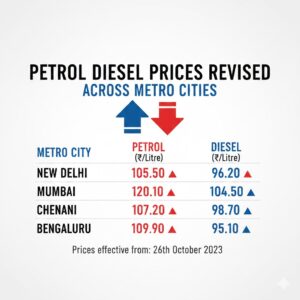



Fuel prices have always been a sensitive and closely watched issue in India. Any fluctuation in petrol or diesel rates directly affects household budgets, transportation costs, inflation, and overall economic sentiment. In recent weeks, while global markets have experienced sharp volatility due to geopolitical tensions, supply disruptions, and uncertain demand patterns, fuel prices in India have largely remained stable. This has sparked curiosity among consumers, economists, and industry experts alike.
Understanding why fuel prices are stable despite global uncertainty requires a closer look at international crude oil markets, India’s pricing mechanisms, government policies, and the role of oil marketing companies.
Global Volatility in Oil Markets
International crude oil prices are influenced by several interconnected factors. Geopolitical tensions in oil-producing regions, production decisions by major exporters, fluctuating demand from large economies, and currency movements all play a role. Over the past few months, global markets have witnessed uncertainty due to conflicts in key regions, concerns over supply chain disruptions, and changing production strategies by oil-exporting nations.
Traditionally, such volatility leads to sharp increases or decreases in retail fuel prices across many countries. However, India has seen relative stability, which stands out when compared to the global trend.
India’s Fuel Pricing Mechanism
India follows a dynamic fuel pricing system where petrol and diesel prices are theoretically revised daily based on international crude prices and foreign exchange rates. However, in practice, oil marketing companies often balance short-term fluctuations to avoid frequent price changes that could burden consumers.
Public sector oil companies factor in long-term averages rather than reacting immediately to every global price movement. This approach helps smoothen the impact of international volatility on domestic fuel prices.
Role of Government Policies
Government intervention has played a crucial role in maintaining price stability. Over the years, the central government and state governments have adjusted excise duties and value-added taxes to cushion consumers from sudden spikes in crude oil prices.
In times of global uncertainty, tax adjustments act as a buffer. When crude prices rise sharply, tax cuts can help stabilize retail prices. Conversely, when crude prices fall significantly, taxes may remain unchanged to protect government revenues. This balancing act has helped maintain relatively stable fuel prices in India.
Strategic Oil Reserves and Supply Management
India has also strengthened its strategic petroleum reserves, allowing the country to manage short-term supply shocks more effectively. These reserves provide a safety net during periods of global disruption, reducing immediate dependence on volatile international markets.
In addition, India sources crude oil from a diverse range of countries. This diversification minimizes the risk associated with overdependence on a single region or supplier, further contributing to price stability.
Impact on Inflation and Economy
Stable fuel prices have a direct positive impact on inflation. Transportation costs influence the prices of essential goods such as food, construction materials, and manufactured products. When fuel prices remain steady, inflationary pressure is reduced, providing relief to consumers and businesses alike.
For the broader economy, predictable fuel prices support planning and investment decisions. Industries such as logistics, aviation, agriculture, and manufacturing benefit from cost stability, which ultimately supports economic growth.

Consumer Relief Amid Rising Living Costs
For households already dealing with rising costs of education, healthcare, and housing, stable fuel prices offer much-needed relief. Daily commuters, small business owners, and transport operators are particularly sensitive to fuel price changes.
By keeping fuel prices steady, purchasing power is preserved to some extent, and consumer confidence remains intact. This stability also helps avoid sudden spikes in public dissatisfaction, as fuel prices are a highly visible and emotionally charged issue.
Global Comparison
While many countries have seen fuel prices fluctuate sharply in response to global market movements, India’s approach has been comparatively cautious. Some nations pass on international price changes almost immediately, leading to frequent adjustments at fuel stations.
India’s method of absorbing short-term volatility has its critics, especially those who argue that it distorts market signals. However, supporters believe it is necessary in a country where fuel costs significantly affect the cost of living for millions.
Long-Term Sustainability Questions
Despite the benefits of stable fuel prices, questions remain about long-term sustainability. Absorbing global price shocks can strain the finances of oil marketing companies. If international prices remain high for an extended period, maintaining stability without price adjustments becomes increasingly difficult.
There is also the challenge of balancing fiscal discipline with consumer relief. Tax revenues from fuel contribute significantly to government budgets, funding infrastructure, social welfare schemes, and public services.
Push Toward Alternative Energy
The current situation has once again highlighted the importance of reducing dependence on fossil fuels. India’s push toward renewable energy, electric vehicles, and alternative fuels is partly aimed at insulating the economy from global oil price volatility.
While fuel prices are stable today, long-term energy security lies in diversification. Investments in solar, wind, biofuels, and EV infrastructure are expected to gradually reduce the economy’s sensitivity to crude oil price shocks.
Market Outlook
Experts believe that global oil markets may continue to experience volatility in the near future due to uncertain geopolitical and economic conditions. However, India’s policy framework and pricing strategy are likely to continue focusing on gradual adjustments rather than abrupt changes.
Consumers may not see immediate price reductions even if global crude prices fall sharply, but they are also less likely to face sudden spikes unless volatility persists over a longer period.
Why This News Matters
Fuel price stability is not just an economic indicator; it directly affects daily life. From the cost of groceries to public transport fares, fuel prices influence almost every aspect of the economy. Understanding why prices remain stable helps consumers make sense of broader economic policies and global developments.
For readers looking to stay informed about such critical developments, platforms like NewsTodayTak play an important role in breaking down complex economic issues into clear and accessible insights. NewsTodayTak consistently tracks policy decisions, market trends, and their real-world impact on citizens.
Conclusion
Fuel prices remaining stable despite global volatility reflect a combination of strategic policy decisions, diversified sourcing, and careful market management. While this stability offers relief to consumers and supports economic confidence, it also requires constant balancing to ensure financial sustainability.
As global uncertainties continue, fuel prices will remain a key area to watch. For timely updates and in-depth analysis on energy, economy, and policy matters, NewsTodayTak remains a reliable source for readers who want clarity beyond headlines.
In the months ahead, the challenge will be to maintain this balance while accelerating the transition toward cleaner and more sustainable energy solutions, ensuring long-term stability for both the economy and consumers.